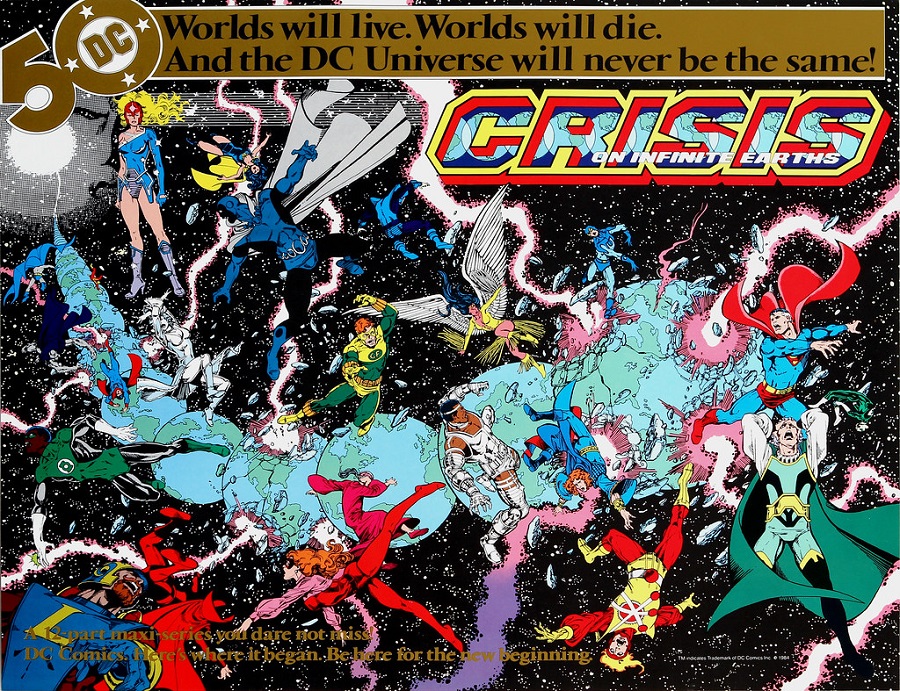
Hello folks, welcome to the very first comic blog on Gaber’s Two Cents. In todays post I will be discussing the ambitious and world shattering 1985 DC Comics event, Crisis on Infinite Earths. However, before we get started, some context must be given before examining this event. I’ll summarize the twelve issue story when needed, but I’m mostly here to give my own opinion on the story as a whole and possibly include my own thoughts on how story beats could have been improved . So sit back and enjoy the ride!
Meanwhile, in San Diego, California, a mild-mannered man named Gaber attempts to provide context for the story that aimed to make DC Comics’ continuity accessible to newcomers while still being familiar to long-time fans…
DC Comic’s continuity before COIE (Crisis on Infinite Earths) was a certified mess. It was as if stories were picked at random when writers were choosing what was considered canon and what was not. The capabilities and power levels of heroes were also much different as well. With Superman in particular having a number of abilities that were more bizarre than helpful. For example, Superman being able to shoot miniature versions of himself from the palm of his hand, weird right?
Another problem that plagued this era is the different versions of characters that seemingly belonged on different earths. Most people don’t know that there were two versions of Superman before this crisis, Kal-L and Kal-El. With Kal-L being the original Golden age Superman stemming from the 1930s, and Kal-El being more similar to the modern Man of Steel we know and are familiar with today. Simply put, a rebirth was needed so that DC could streamline all of their properties into a cohesive world that felt lived in and connected.
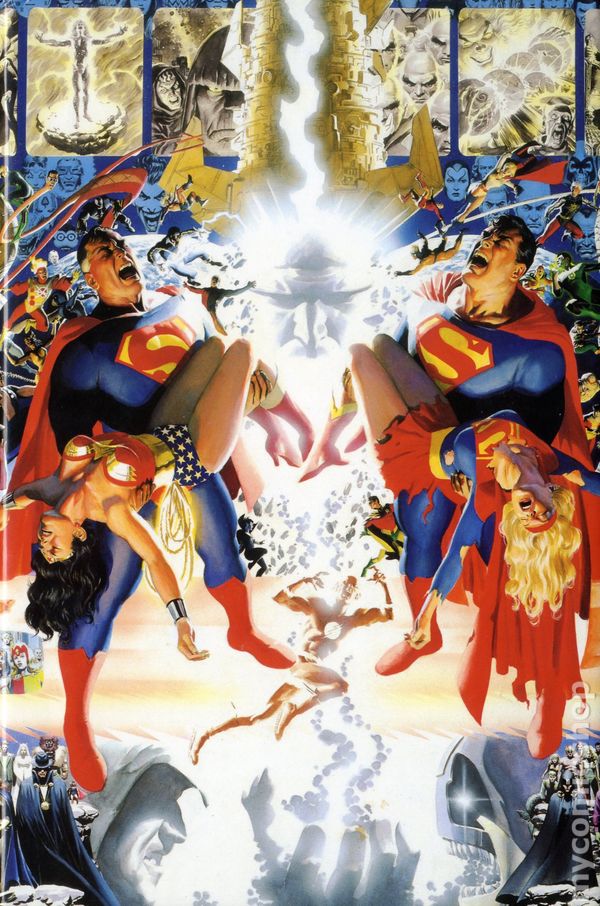
Kal-L on the left and Kal-El on the right.
The story begins with a being named the Monitor who’s watching several heroes closely throughout the Multiverse, waiting for the right moment to bring them into the conflict against his counterpart, the Anti-Monitor. The Monitor tasks his underling, Harbinger, with the mission of rounding up the biggest and most powerful heavy hitters that the DC universe has to offer. The list of heroes includes both Supermen, Superboy, Supergirl, Batman, Flash, Blue Beetle, Aquaman, Green Lantern, Wonder Woman, and even more lesser known heroes like Peacemaker. On a side note, it’s very interesting to see characters like Peacemaker get the spotlight in this story. As most people know now, Peacemaker was in James Gunn’s 2021 film, The Suicide Squad, but the character was regulated to the sidelines for quite sometime after the events of COIE. Even in the main story, the character does not impact the main plot, but his inclusion with other A list heroes is interesting nonetheless.
Another interesting tidbit that must be mentioned is how Batman makes little to no impact in this crisis whatsoever. It’s strange because he was arguably just as popular as Superman at the time, and to see him in the background of panels rather than having any focused on him was an interesting creative choice that in my opinion was detrimental to the story as a whole. Like it or not, Batman is integral to the success of DC Comics, so regulating him to the sidelines is a bizarre choice.
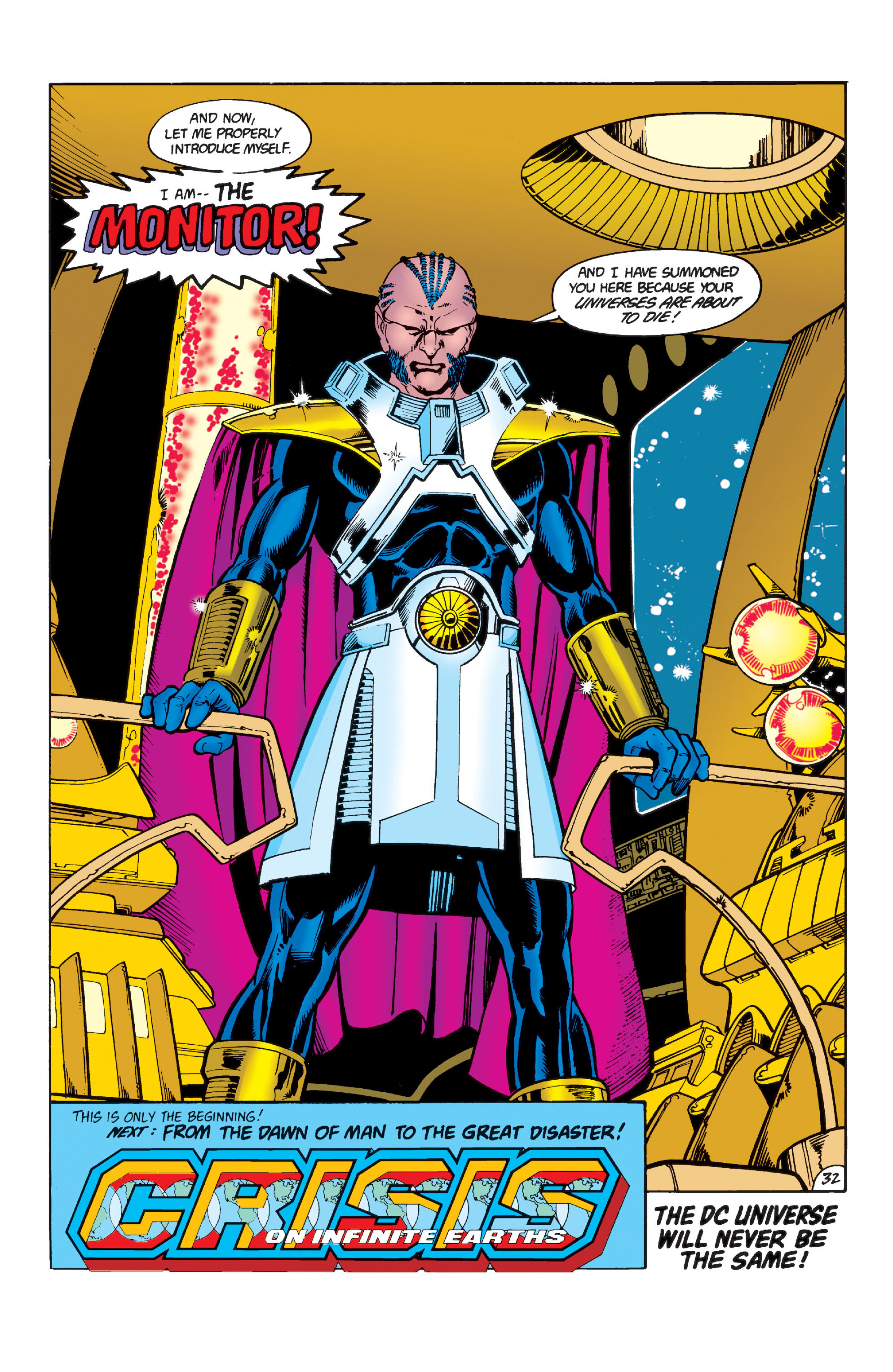
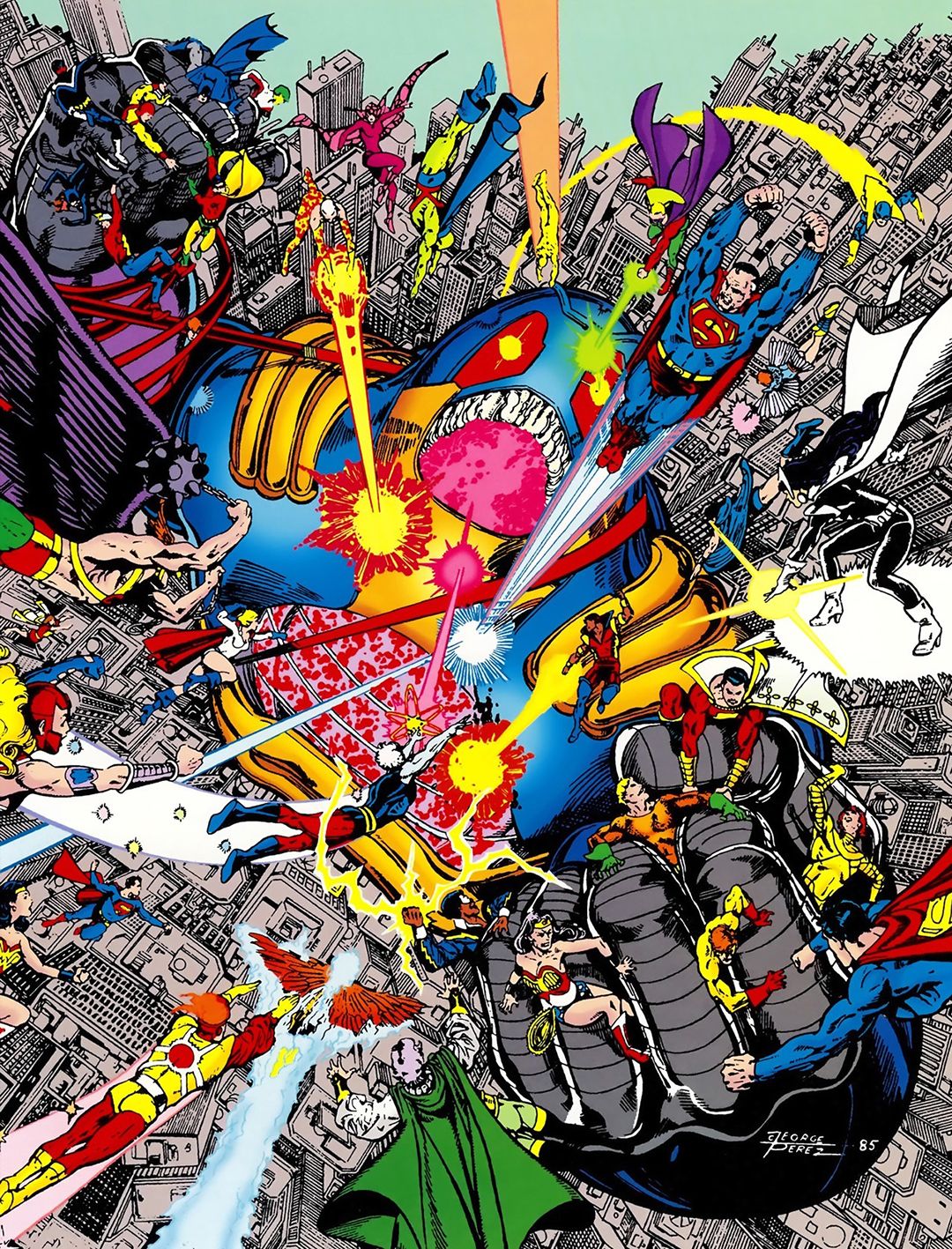
Speaking of the Anti-Monitor, what’s his deal anyway? He and his counterpart, the Monitor, are essentially polar opposites of one another. With the Monitor wanting to preserve the life contained within the Multiverse, and the Anti-Monitor, drumroll please, wanting to obliterate all life altogether. While the Anti-Monitors motives aren’t the most original or groundbreaking, I understand the reasoning for wanting DC’s first big event to have a villain whose morality is very much black and white, since it provides a very simple excuse for every hero to crossover, without convoluting the story in a way that could be confusing to the newcomers that the company is trying to cater to.
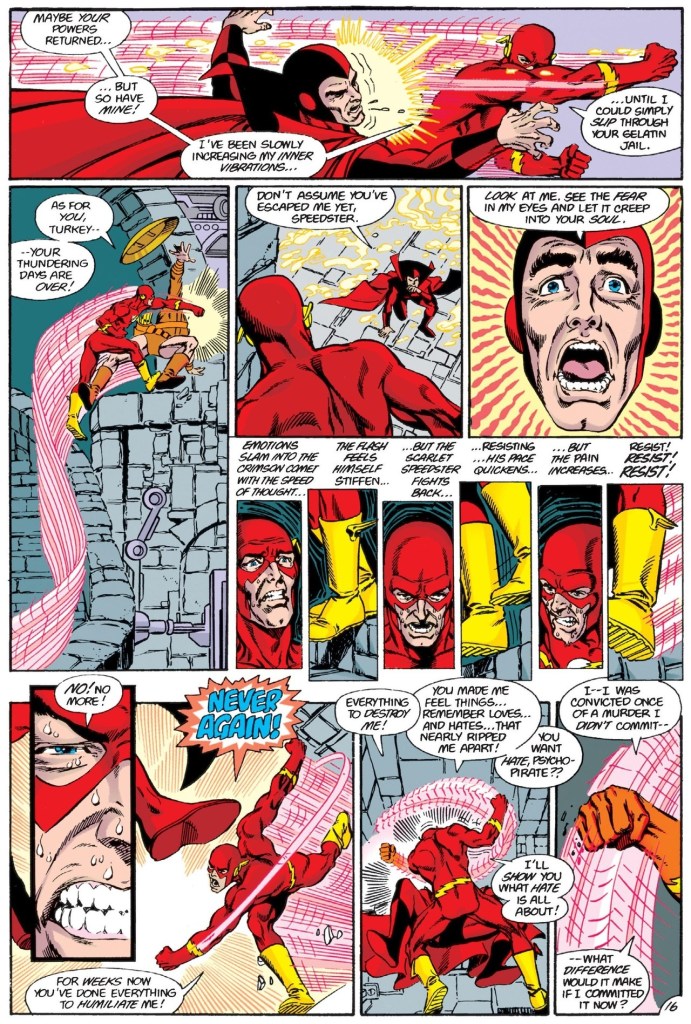
Still following along? Cool, let’s get to the standout villain who is more interesting and far more intimidating than the Anti-Monitor, Psycho Pirate. Psycho Pirate’s abilities involve being able to reflect whatever emotion he wants onto anyone who looks upon his mask, he uses this ability several times throughout the storyline, however the most prominent example would be when he is tasked with keeping the second Flash prisoner, Barry Allen. Rather than simply keeping watch over Barry, Pirate spends most of his time breaking the flash mentally, projecting fear and desolation over the Flash. This is arguably one of the most important moments in the book, with Barry using all of the willpower he has left to overcome Psycho Pirates influence. Barry eventually succeeds and proceeds to beat the shit out of Psycho Pirate. This moment in particular is a testament to why Barry Allen’s character was and still is so important today, he doesn’t give up and will sacrifice himself if needed for the greater good.
Speaking of sacrifices, lets talk about another reason COIE is remembered so well. There are two very big deaths contained in the story, which altered DC for quite some time. The characters who met their demise were Barry Allen and Supergirl, with Barry Allen’s being a tad more monumental in the long run. Without confusing the hell out of you, long story short, the Anti-Matter is close to destroying what’s left of the entire Multiverse with his Anti-cannon (trust me I know, bear with me) the flash basically creates a speed vortex which absorbs the blast of the cannon, the power that the Flash absorbs becomes too much and he disintegrates while he is racing to save the world. It’s a truly shocking demise for one of DC’s most popular heroes, and altered the Flash’s comics by keeping the character dead for over two decades, a feat that rarely occurs within the world of comics.
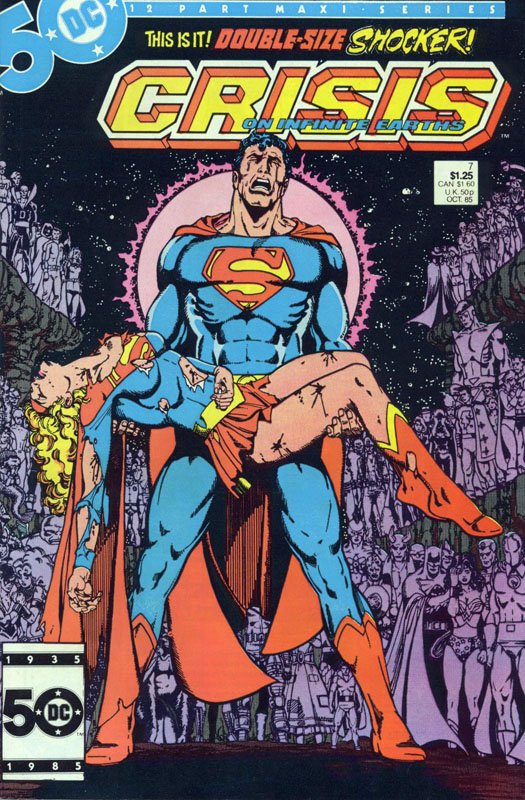
Then we have the death of Supergirl, who’s death is just as shocking and a tad more Brutal than Barry Allen’s. With all of the Multiverses heroes leading a final assault on the Anti-Monitor, Superman and Supergirl reach him first. Superman is ambushed by the Anti-Monitor and is subsequently battered by the villain, Supergirl hearing her cousins screams breaks through the Anti-Monitor’s fortress and nearly beats him to death before reverting her attention back to Superman. Taking advantage of this, the Anti-Monitor sends an energy blast through Supergirl’s back while she is not looking, she is fatally wounded and succumbs to her injuries, a panel reflecting the death is shown with Supergirl dead in her cousin’s arms.
Now, on to my favorite part of the story, the climatic battle that takes place after the seemingly defeated Anti-Monitor returns for one last bout. With already several heroes meeting their demise, Kal-L, Kal-El, and Superboy lead the charge in the last fight to save the Multiverse. The fight that ensues is genuinely striking, with action on almost every page, and all three Supermen no longer holding back with their blows. With the fight coming to a close, Kal-L and Superboy instruct Kal-El to return to his homeworld while there is still a chance, while they hold off the Anti-Monitor. Kal-L the original Man of Steel delivers one final punch that instantly kills the Anti-Monitor, and sends a shockwave through the Multiverse.
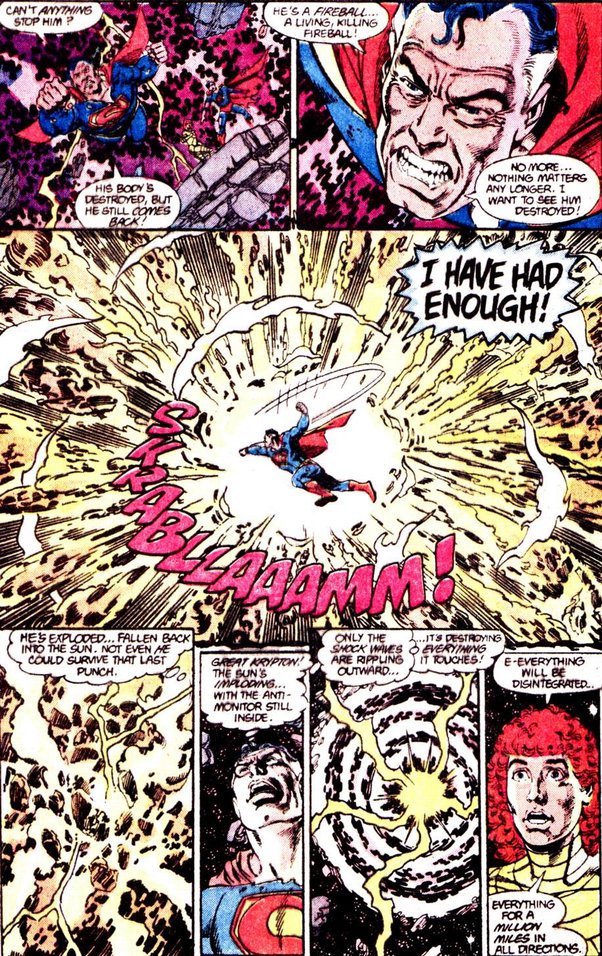
In retrospect, Kal-L is one of my favorite aspects of the story. He embodies the Man of Steel persona, yet his morals and values have strayed little from their original form. This realization makes the impactful moment above even more poignant as it reflects the essence of the character when he was first created. The gray in his hair serves as a symbol of his experience, suggesting that this may be his final adventure. Even his dialogue echoes the simple and optimistic themes that were prevalent during the Golden Age of comics. He is a variation of the character that I hope to see on the big screen one day, as his particular schtick as a man out of time is both relevant and intriguing.
After the dust settles, the multiple worlds of DC Comics’ multiverse have been merged into a single world, marking the realization of the company’s first rebirth. Following the events of COIE, virtually every main series in DC Comics underwent a story reboot and origin alteration to reflect the changes brought about by the crisis.
Thanks for taking the time to check this out! Feel free to tap Thumbs Up button down below and subscribe if you want to be notified for new posts each week and share with anyone interested in learning about the first ever rebirth in DC Comics. Thank you all and we will see you next week on Gaber’s Two Cents.


Leave a Reply